
 EN
 AR
 FR
 DE
 IT
 JA
 PT
 RU
 ES
 NL
 RO
 PL
 VI
 GA
 MS
 SK
 SV
 IW
 KO
 TL

Edge Protection Barrier vs Scaffold Guardrail: Choosing the Right System for Your Edge
Both systems keep people away from a drop. Both are temporary, both are demountable, and on a good day both will pass an inspector. They are also built on completely different logic — one is a fabricated structure, the other is a manufactured product — and that difference shows up in the things that actually cost money: installation hours, containment performance and what you get back when the job is over.
This comparison sets out where each system genuinely wins, so you can choose on the right criteria rather than on what is already in the yard.
What Actually Separates the Two Systems?
Three differences explain almost everything else.
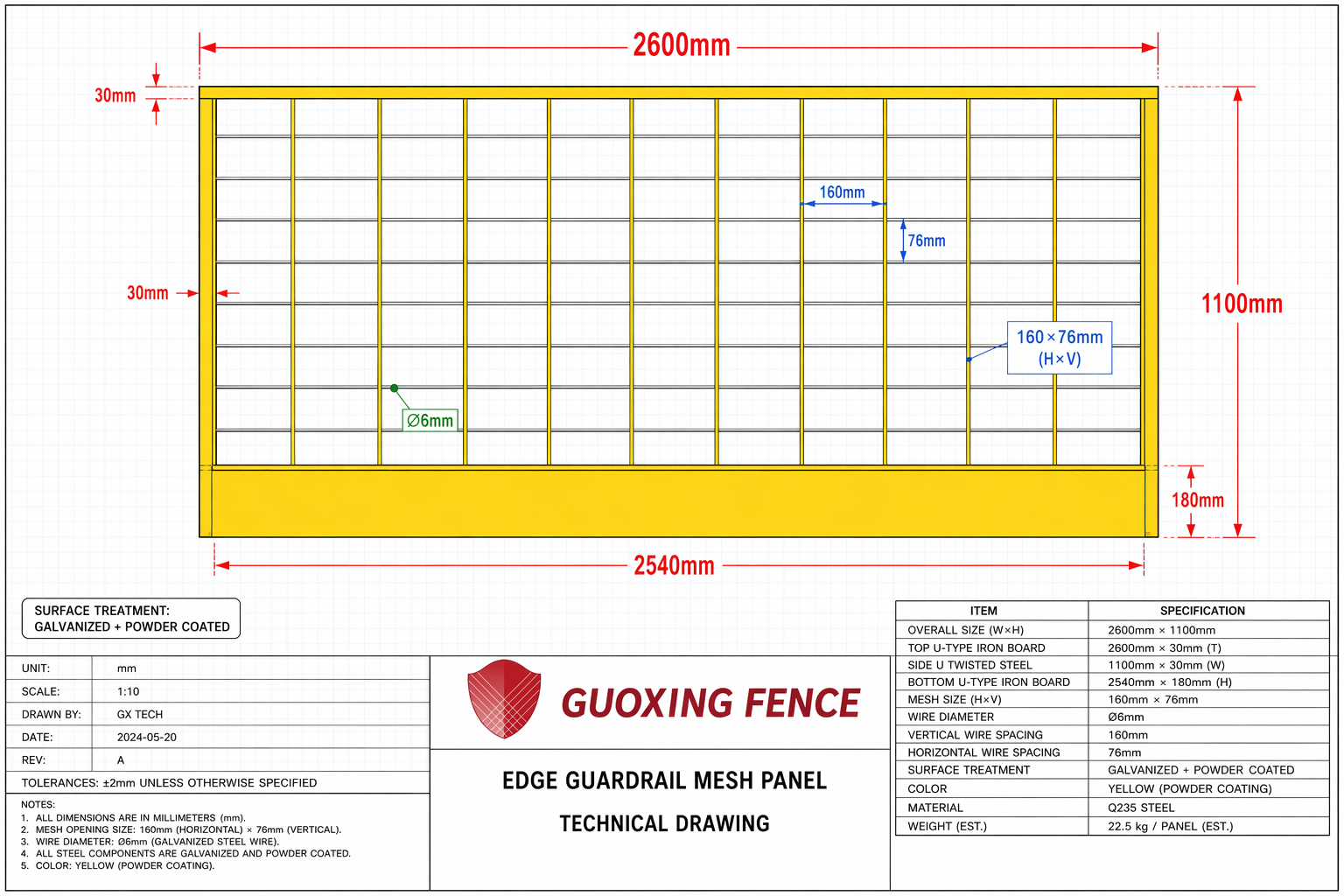
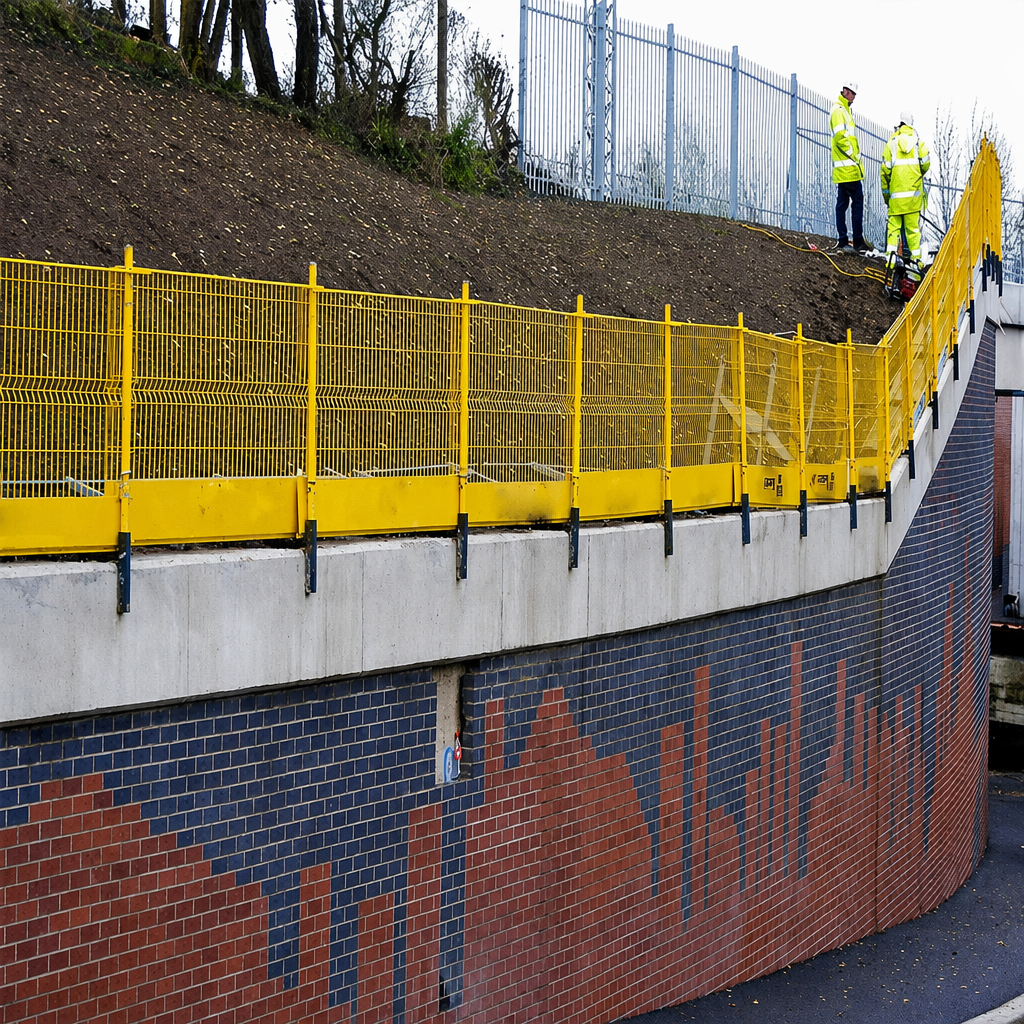
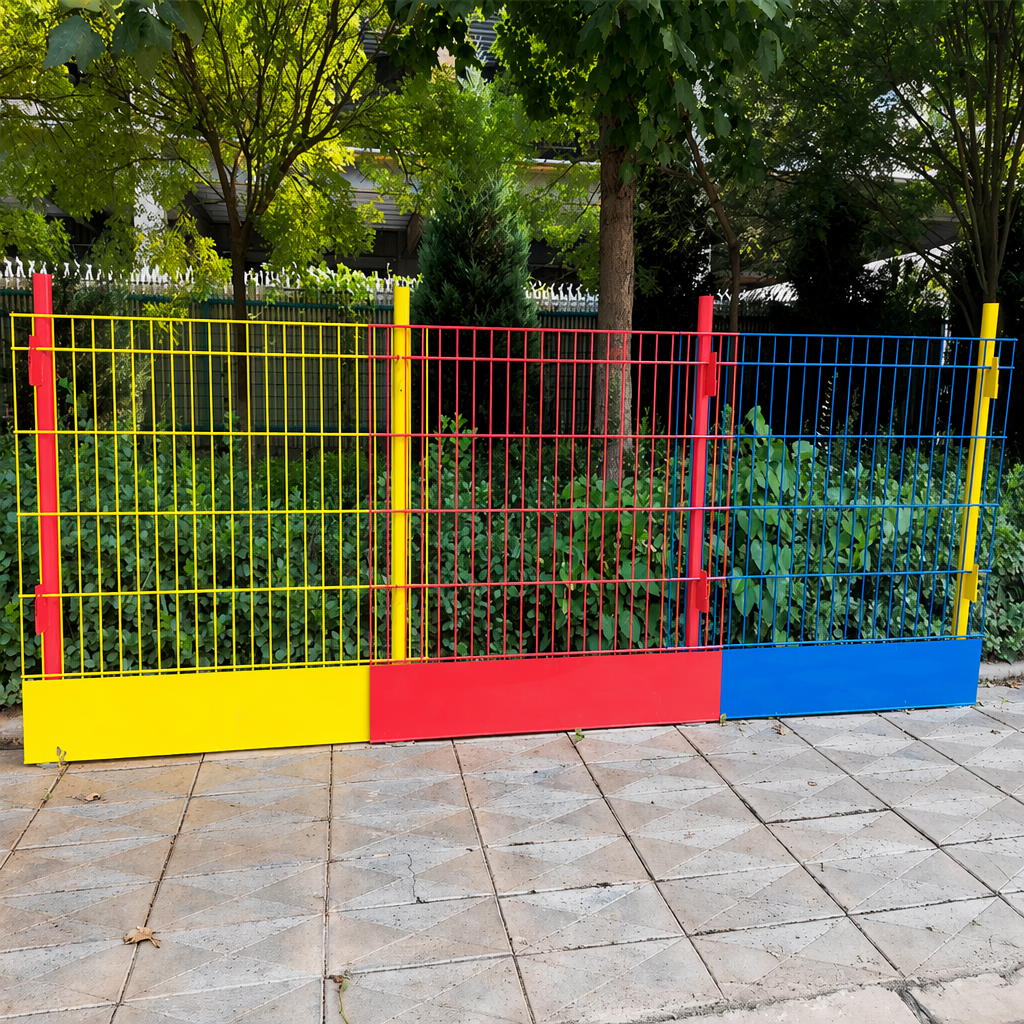
The structure: a finished panel versus an assembled frame. A mesh edge protection barrier arrives as a welded panel on a post, with the mesh and the frame already one unit. A scaffold guardrail is assembled on site from tube, couplers, standards and boards, then dismantled into the same loose components. The panel system trades flexibility for speed; the tube system trades speed for the ability to follow any geometry you can scaffold.
The containment: continuous mesh versus rails and a toe board. A scaffold guardrail protects people with a top rail, a mid rail and a toe board. It is effective at stopping a person and at deflecting large objects, but the openings between the rails are open. A mesh barrier closes the face continuously at 50 x 50 mm or 75 x 75 mm, which is what makes it effective against the objects that actually fall on construction sites — hand tools, fixings, offcuts and fragments. If there is a public footpath, a live road or another trade working below your edge, that difference is the whole argument.
The logistics: stacked panels versus loose tube. Panels stack flat and load as a panel, which makes them predictable to transport, count and store. Tube and fittings arrive as a mixed load that has to be sorted before it can be erected, and couplers are the components most likely to go missing between projects. For a contractor moving protection from edge to edge, the panel system's advantage is not that it installs faster in the first hour — it is that it is ready to install at all.
Real-World Scenarios: Where the Choice Becomes Obvious
Scenario One: The Multi-Level Slab With a Public Interface
A builder protecting a suspended slab above a public footpath has two separate obligations: keep the workforce from falling, and keep material from reaching the street. A scaffold guardrail with a toe board addresses the first. A tight-mesh barrier addresses both, because the mesh closes the face rather than leaving it open between rails. On sites with a public interface, that usually decides the specification before installation cost is even discussed.
Scenario Two: The Subcontractor Who Already Owns Scaffold Gear
A subcontractor with a yard full of tube and fittings will reasonably ask why they should buy a second system. The honest answer is that they should not, if their edges are simple, their crews are scaffold-trained and containment is not a live issue. The case for a panel system appears when the same crew is spending hours assembling and stripping guardrail at every stage, or when they are working edges that cannot take a scaffold tie. Buying a system is only cheaper than using the one you own when the labour it saves exceeds what it cost.
Scenario Three: The Project Where the Edge Changes Every Week
A staged construction programme changes the protected edge repeatedly — this week a slab perimeter, next week a roof line, the week after a void. A fabricated scaffold guardrail is designed for one configuration and rebuilt for the next. A panel-and-post system moves with the edge, because the panel is the unit and the post fixing is the variable. For programmes with a fast stage cycle, that is usually the deciding factor.
Scenario Four: The Hire Company Deciding Which to Stock
Hire businesses stock what comes back in rentable condition. Scaffold guardrail comes back as tube with bent standards and missing couplers; mesh panels come back with deformed mesh and, less often, bent frames. The two have different repair economics — mesh can often be straightened and re-coated, while a bent standard is scrap. A hire company's decision should follow its repair capability more than its purchase price.
Questions We Hear Most Often
Q: Is a mesh barrier acceptable where the project specifies scaffold guardrail? Only if the project specification allows it. Many Australian specifications are written around AS/NZS 4994.1 for temporary edge protection rather than around a named system, in which case a mesh barrier that meets the standard's requirements can be submitted. Where the specification names scaffold guardrail explicitly, substituting a different system is a variation that has to be approved, not a purchasing decision.
Q: Which system goes up faster? For a straight, repeatable edge, a panel-and-post system is generally faster because there is nothing to assemble — the panel and the mesh are already one unit. For an irregular edge with many returns and penetrations, tube and fittings can be faster because it adapts without cutting. The honest answer depends on the geometry of the edge, not on the product category.
Q: Can a mesh barrier stop dropped tools and debris? That is precisely what the tight mesh is for. At 50 x 50 mm and 75 x 75 mm, the face is closed to hand tools, fixings and most offcuts in a way that rails alone cannot achieve. It is not a substitute for a catch platform or a debris net over a public interface, but it is a materially better containment surface than an open rail system.
Q: Which is cheaper across multiple projects? Compare cost per protected metre per project, not purchase price per unit. A panel system carries a higher unit price and a lower labour cost per installation; scaffold guardrail carries a lower material cost if you already own it and a higher labour cost every time it goes up. Over several projects the number that matters is labour hours plus replacement of damaged components, and that usually favours the panel system on repetitive edges.
Q: Can the two systems be combined on one edge? Yes, and on complex sites they often are — panels on the long straight runs, scaffold guardrail or fabricated protection around penetrations, returns and plant rooms. The constraint is that the transition between the two has to be closed, because a gap at a change of system is exactly where the containment fails.
Q: What does AS/NZS 4994.1 actually cover? It is the joint Australian and New Zealand standard for temporary edge protection, covering general requirements for the design, dimensions and performance of the barrier. Installation and dismantling of roof edge protection is covered separately by AS/NZS 4994.2. Compliance is a property of the installed system on your edge, not of a panel in a warehouse — which is why the fixing detail and the installation method matter as much as the product.
Why Buyers Choose Guoxing Edge Protection Barriers
Anping Guoxing Wire Mesh Products manufactures edge protection barriers in the heart of the world's wire mesh industry — Anping, China. The range covers panels from 1100 x 1300 mm to 1300 x 2200 mm, in 4.0 mm to 8.0 mm wire, with mesh openings from 50 x 50 mm to 50 x 200 mm, on 1100 mm or 1300 mm posts in 48 mm round or 40 x 40 mm square section, in powder coated, hot-dip galvanised or galvanised finish. Every panel is produced under ISO 9001 quality control, with CE and SGS certification available on request.
If you are comparing a mesh system against scaffold guardrail on a specific edge, send us the edge detail and the containment requirement, and we will quote the panel, post and fixing configuration that meets it — with the documentation your submission needs.
Need a tailored quotation for your project? Contact the Guoxing team today — we respond to all inquiries within 24 hours.