
 EN
EN
 AR
AR FR
FR DE
DE IT
IT JA
JA PT
PT RU
RU ES
ES NL
NL RO
RO PL
PL VI
VI GA
GA MS
MS SK
SK SV
SV IW
IW KO
KO TL
TL
Australian vs Canadian Temporary Fencing: Which Format Fits?
Australian vs Canadian Temporary Fencing: Choosing the Right Panel Format for Your Market
Both fences do the same job. Both are welded steel mesh panels standing on base feet, both are hot-dip galvanised, and both are assembled and struck by two people without ground works. Put an Australian temporary fence panel next to a Canadian one, though, and almost nothing on them matches — not the frame, not the base, not the panel format, and not the finish.
That matters more than it sounds. A temporary fence is a system: the panel, the base and the clamp are engineered as one unit, and the wind behaviour of that unit is what your site is actually relying on. A panel that suits one market's base system is not a substitute for the other's.
This guide sets out what genuinely differs between the two formats, and how to decide which one your project or your product line needs.
What Actually Differs Between the Two Formats?
Three differences decide everything else that follows.
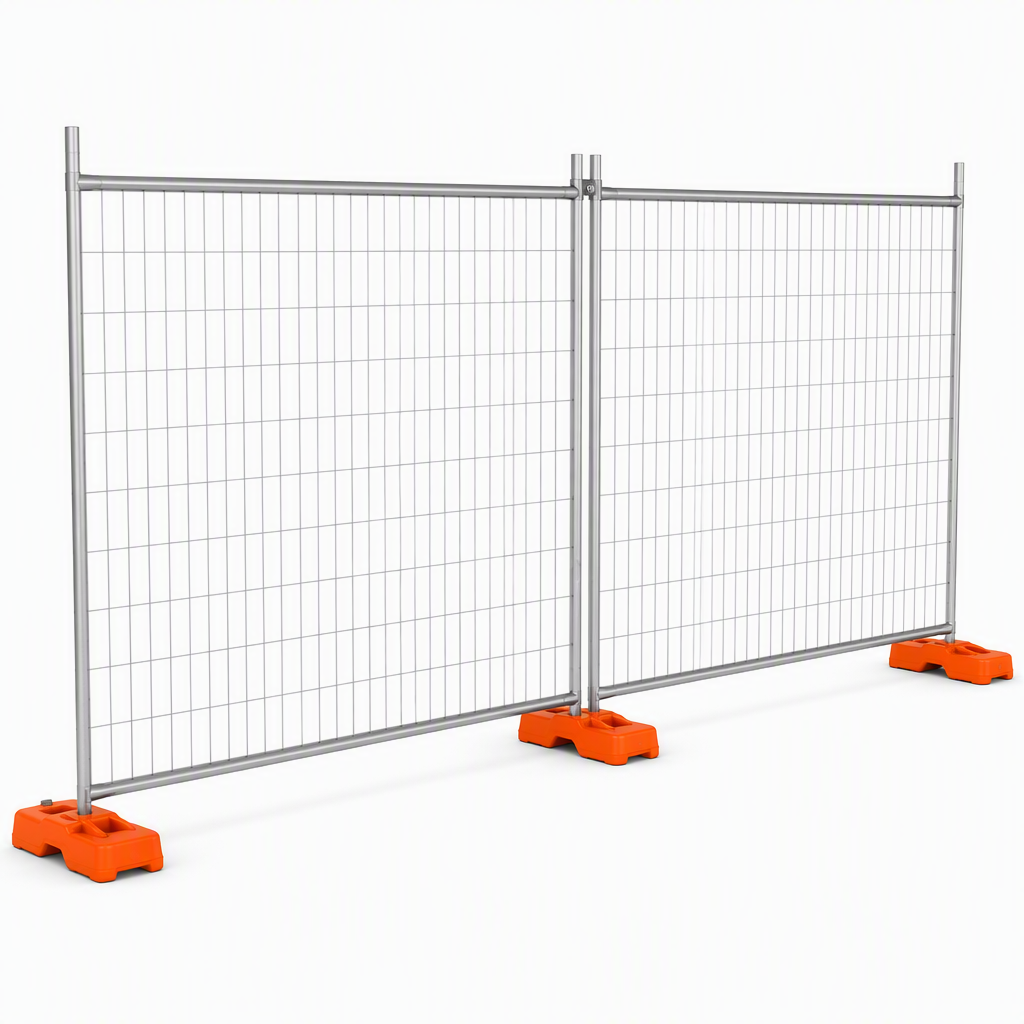
The frame: round tube versus square tube. Australian temporary fencing is built on a full round-tube welded frame — commonly OD 32 mm, 38 mm or 42 mm. The North American format typically uses square tube in 25 x 25 mm or 30 x 30 mm. Round tube is the Australian convention largely because it suits the clamp and socket hardware that the market standardised on, and because a round section deflects an impact across its whole circumference rather than concentrating it on a flat face. Square tube gives a stiffer flat plane and a wider bearing surface where it meets the base, which is why it became the North American norm alongside much wider panels.
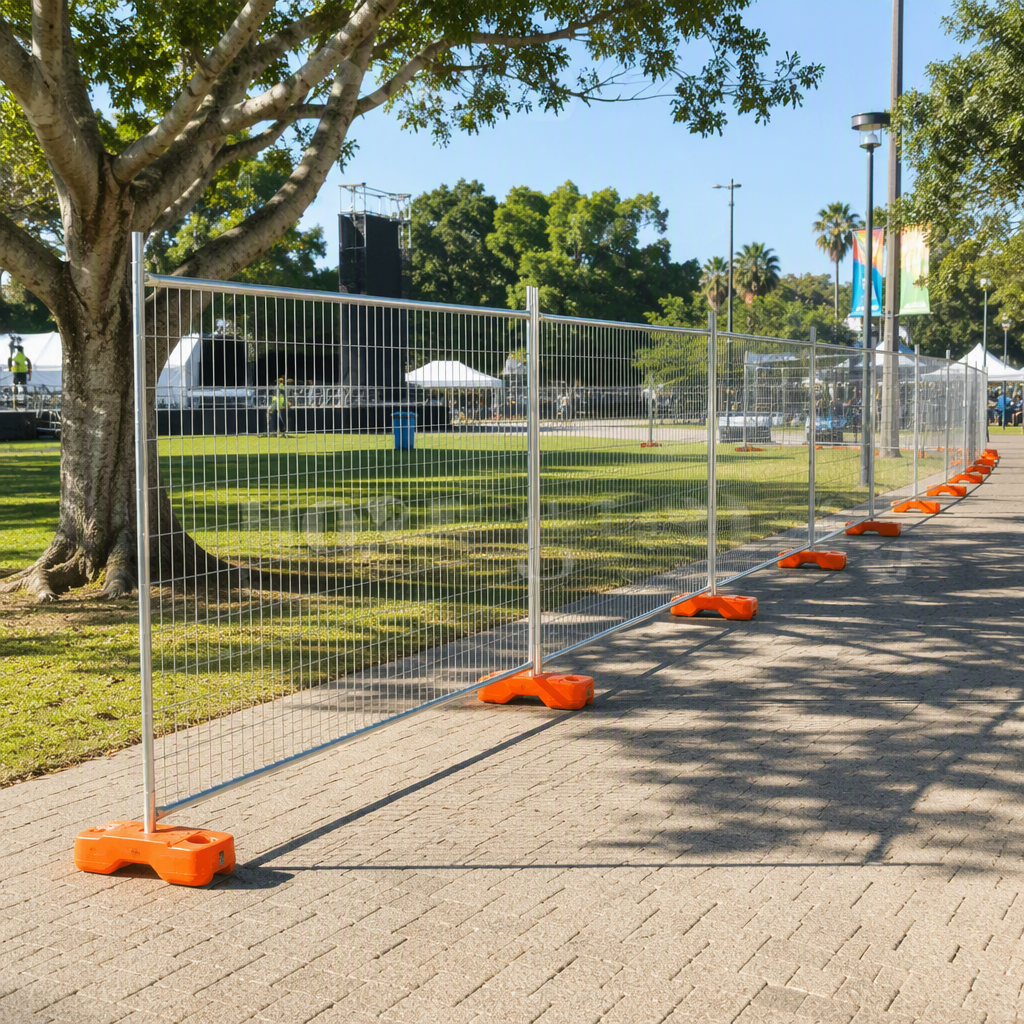
The base: mass versus steel. Australian panels stand on a blow-moulded plastic foot in high-visibility safety orange, filled with concrete to roughly 28 to 32 kg, measuring 600 mm long by 220 mm wide by 150 mm high, with twin sockets for the panel legs. North American panels normally stand on a welded steel bar foot — flat steel plates around 860 mm to 890 mm long, in a yellow finish. The Australian approach buys its stability with mass and a high-visibility footprint that is easy to see from a vehicle. The steel foot buys its stability with a low, wide steel profile and packs flat for transport.
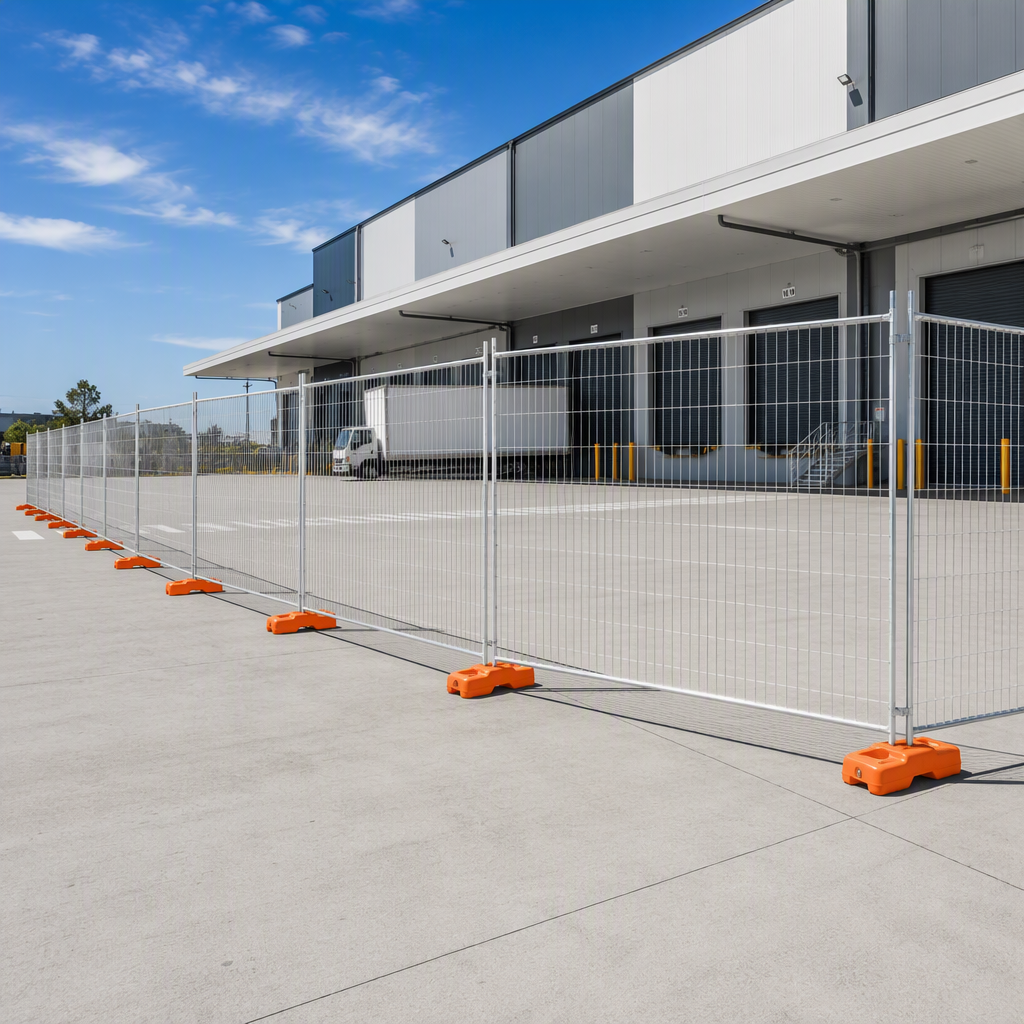
The finish: corrosion protection alone, or corrosion protection plus colour. Australian temporary fencing is conventionally supplied as straight hot-dip galvanised steel, with the silver-grey metallic finish left visible. The North American market has largely moved to galvanising plus a powder coat — a green mesh with a yellow base being the familiar combination. One is a corrosion system; the other is a corrosion system with a colour and branding layer on top.
Two more practical differences follow from those three. The standard Australian panel is 2100 mm high by 2400 mm wide, against the North American 1800 x 2900 mm and 2400 x 2900 mm. And the design priority differs: Australian specifications lean on anti-climb mesh behaviour, coastal corrosion resistance and heavy base weight for wind resistance, while North American specifications lean on wide panel spans, square-tube rigidity and the convenience of a double-tube push-fit assembly.
Real-World Scenarios: Where the Choice Becomes Obvious
Scenario One: The Australian Hire Company Tendering to a Tier 1 Contractor
Picture a hire company pricing a perimeter package for a Tier 1 builder's site. The builder's documentation will specify a panel format, a mesh opening and a base type, and the submission is assessed against those documents. Turning up with a format from another market is not a cost advantage — it is a compliance question the contractor has to resolve, and that costs more time than any saving on the panel. In Australia, buying the Australian format is a procurement decision before it is a technical one.
Scenario Two: The North American Distributor Adding a Fence Line
A distributor in Canada or the United States adding temporary fencing to an existing catalogue faces the mirror image. Its customers buy by the thousand in a 6 x 9.5 ft format, they already hold steel bar feet and matching clamps in their yards, and they expect the double-tube assembly they are used to. Introducing a round-tube panel with 30 kg plastic feet into that market means selling a new base system with every panel. The format that sells is the one the local fleet already fits.
Scenario Three: The Contractor Working Both Markets
Some buyers need both, and this is where the two formats genuinely earn their place side by side. A contractor running Australian and North American projects cannot standardise on one panel, because the base systems are not interchangeable and the panel footprints do not match. The practical answer is to buy each format to its own market's specification and keep the fleets physically separate — colour-coding or marking the base feet by market is a cheap way to stop the two getting mixed on a shared laydown yard.
Scenario Four: The Events Business That Specifies by Footprint
For events and crowd management, the deciding factor is often linear metres per container rather than wind behaviour. The Australian 2100 x 2400 mm panel and the North American 2400 x 2900 mm panel occupy genuinely different volumes once stacked with their feet, and the plastic concrete-filled foot and the flat steel foot consume space in different ways. Before committing to a format, ask for a loading plan and work out your cost per linear metre delivered — for a business that ships fleets rather than single orders, that number decides more than the unit price does.
Questions We Hear Most Often
Q: Can I use a North American temporary fence panel on an Australian site?
Not as a drop-in substitute. The base systems differ, the clamps differ and the panel footprint differs, so the assembled system is not the format Australian site documentation describes. If you hold North American stock and want to sell into Australia, the realistic route is to source the Australian format rather than to re-engineer the old stock.
Q: Which format handles wind better?
Neither format is inherently better — the base and the bracing decide the outcome. In the Australian system, stability comes from base mass of roughly 28 to 32 kg per foot plus a 2.1 m galvanised bracing stay on exposed runs. In the North American system, it comes from a low, long steel foot and a wider panel span with more clamps per linear metre. Whichever format you buy, specify the bracing and the base for the wind exposure on the site rather than assuming the panel alone is enough.
Q: Why do Australian bases weigh around 30 kg when North American feet are steel?
Because the two markets solved the same problem with different materials. The Australian foot is a UV-stabilised blow-moulded shell filled with concrete, which puts the mass low and central and makes the base highly visible in traffic orange. The North American foot is a welded steel bar that is flatter, lighter to handle by hand, and packs more efficiently in a stack. Both work; they just make different trade-offs between handling, visibility and packing.
Q: Which format is cheaper to freight?
It depends on how the base and the panel stack, not on the panel size alone. The concrete-filled plastic foot is bulky relative to its mass, while the steel bar foot is dense and flat. Work the comparison out on a loading plan: cost per linear metre of fence delivered, including the feet, is the number that matters. Anything else is comparing unit prices with different packing assumptions behind them.
Q: Can one supplier produce both formats?
Yes, and buying both from one source removes the biggest risk in a dual-market programme — mismatched batches of tube, mesh and coating across two product lines. What you should ask for is a written specification for each format separately: tube section in millimetres, mesh opening, wire diameter, coating, base dimensions and base mass. If a supplier quotes one specification and calls it "suitable for both markets", that is not a specification.
Q: Can I get the accessories to match either format?
Accessories have to match the system, not the panel. The Australian format uses hot-dip galvanised stamped clamps, 4 mm thick, at 75 mm or 100 mm centre distance with galvanised bolts and nuts, plus a 2.1 m galvanised bracing stay with twin base locking clips. Specify the accessories with the panel, in the same order, so the clamps and stays arrive matched to the tube you are receiving.
Why Buyers Choose Guoxing Temporary Fencing
Anping Guoxing Wire Mesh Products manufactures temporary fencing in the heart of the world's wire mesh industry — Anping, China. We build both the Australian round-tube format and the North American square-tube format, in both base systems, so a distributor or a dual-market contractor can source a matched fleet from one production line. Every panel is produced under ISO 9001 quality control, with CE and SGS certification available on request, and our export experience covers more than 30 countries across the Middle East, Europe, the Americas and Oceania.
Tell us which market you are supplying and we will quote that format specifically — panel size, tube section, mesh opening, base type and finish — with a loading plan and the documentation your customer's project file needs.
Need a tailored quotation for your project? Contact the Guoxing team today — we respond to all inquiries within 24 hours.