
 EN
EN
 AR
AR FR
FR DE
DE IT
IT JA
JA PT
PT RU
RU ES
ES NL
NL RO
RO PL
PL VI
VI GA
GA MS
MS SK
SK SV
SV IW
IW KO
KO TL
TL
Australian Temporary Fencing The Complete Buyer's Guide
Australian Temporary Fencing: The Complete Buyer's Guide to Compliant, Reusable Site Security
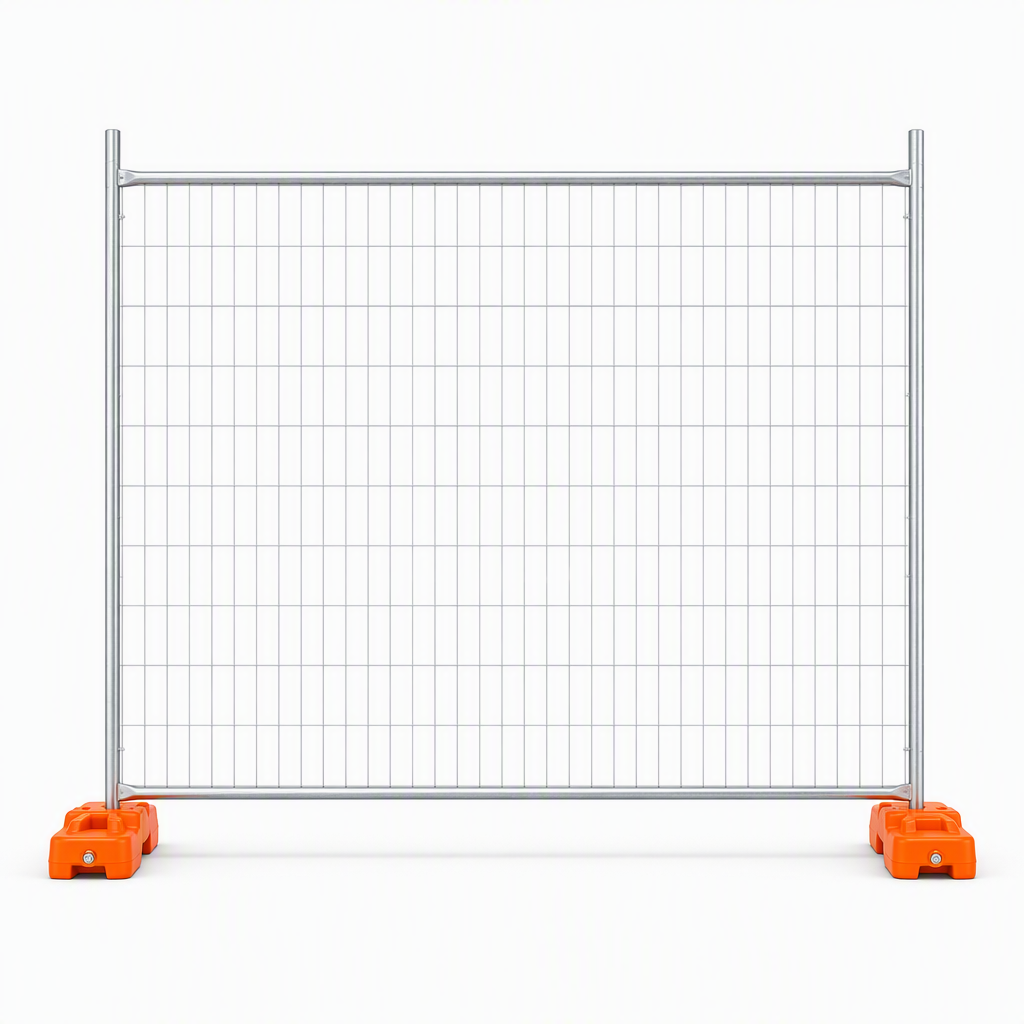
Walk the perimeter of almost any construction site in Australia and you will see the same thing: rows of steel mesh panels, 2.1 metres high, locked together in a long line, each one standing on a bright orange concrete-filled foot. That is Australian temporary fencing — a mobile, fully welded, hot-dip galvanised perimeter system that needs no trenching, no concrete pour and no permanent fixing into the ground.
But what actually separates a temporary fence that passes handover from one that gets pulled off site before the job finishes? How do you work out which specification you need? And is a higher price per panel ever the cheaper answer?
This guide answers the questions Australian contractors, hire companies, councils and importers ask us most often — with the specification detail and the site scenarios that decide the answer.
What Makes Australian Temporary Fencing Different?
An Australian temporary fence panel begins as a welded mesh panel set in a full round-tube frame. Three design decisions separate it from temporary fencing built for other markets.
It is built to one national panel format. Australian sites have converged on a single panel size: 2100 mm high by 2400 mm wide. That standardisation is not cosmetic. Because the whole market builds to the same footprint, a panel from one batch locks to a panel from another, base sockets are interchangeable, and a hire company can rebalance its fleet without tracking which generation of stock it is holding. The frame is round tube — commonly OD 32 mm, 38 mm or 42 mm, with a wall thickness between 1.5 mm and 2.0 mm. Worksite requirements reference AS 4687.1, Temporary fencing and hoardings, and it is this combination of panel format, anti-climb mesh and stability provisions that those requirements turn on.
It is designed to deny a foothold. The standard mesh opening is 60 x 150 mm, welded from 3.0 mm to 4.0 mm wire. That aperture does two jobs at once: it offers no horizontal purchase for a hand or a boot, and it still lets wind pass through the panel instead of loading it like a sail. Where a tighter barrier is needed, 50 x 100 mm and 75 x 75 mm openings are available on the same frame.
It stands on mass, not on ground works. Every panel leg drops into a twin-socket base: a blow-moulded, UV-stabilised shell in high-visibility safety orange, filled with concrete to around 28 to 32 kg. The foot is 600 mm long, 220 mm wide and 150 mm high, with a moulded arch underneath that stops water pooling in the base and removes a trip edge at ankle height. On exposed runs, corners and any section carrying shade cloth or signage, a 2.1 m galvanised bracing stay clips to the base to lift the system's wind resistance.
Real-World Scenarios: Where Australian Temporary Fencing Earns Its Keep
Temporary fencing is bought for four very different reasons. The specification that solves one is often the wrong answer for another.
Scenario One: The Road Rehabilitation That Had to Keep Traffic Moving
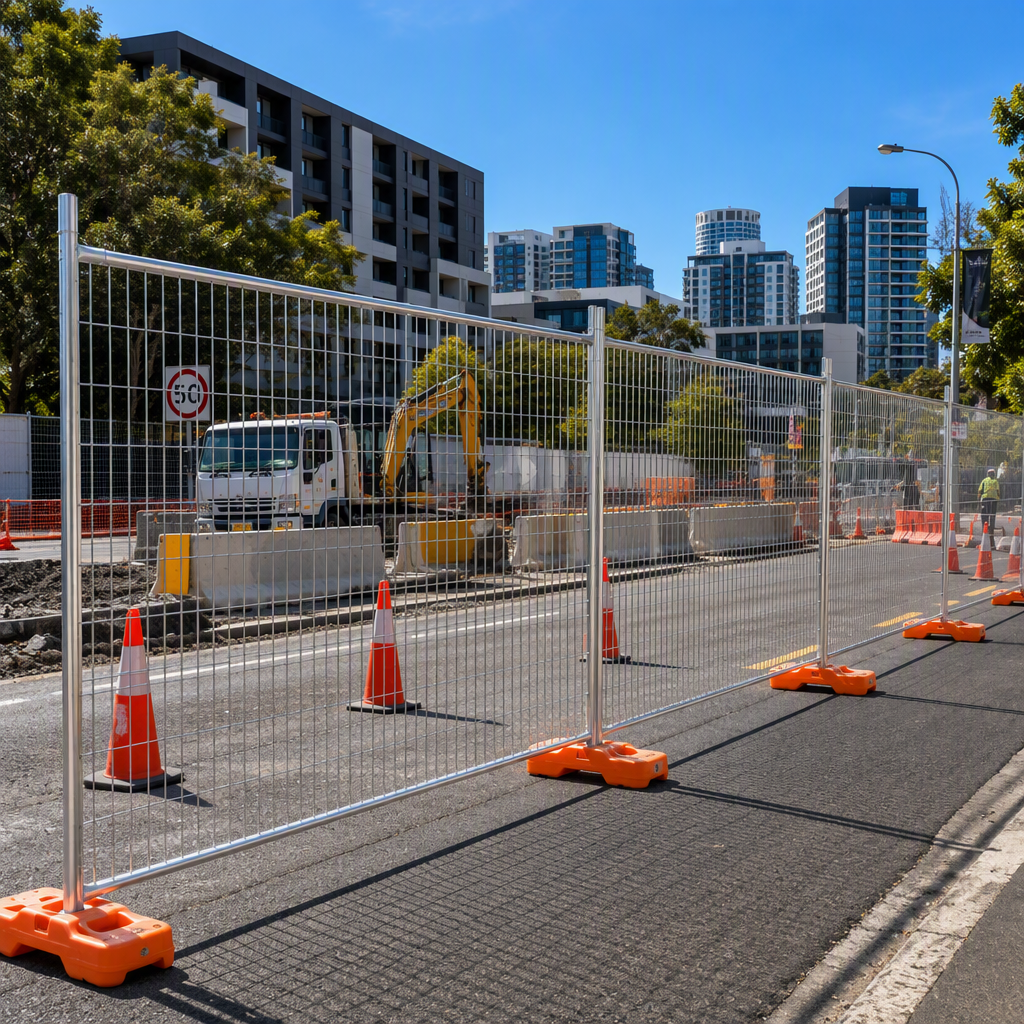
Picture a metropolitan road rehabilitation job with live traffic on one side and an open excavation on the other. The constraint is time on the road — every hour spent erecting and striking fencing is an hour not spent sealing. Two people can carry, place and clamp a run of panels with no tools beyond the clamps themselves, because nothing is fixed into the ground. The base weight does the work a trench would normally do. For roadwork and civil crews, that is the real value of the product: the control zone goes up and comes down inside the shift.
Scenario Two: The Housing Estate That Needed a Line Residents Would Accept
A residential development has a problem industrial sites do not: the perimeter is part of the streetscape, and buyers read it as a signal about the project. A solid hoarding reads as a construction barrier for as long as it stands. Open 60 x 150 mm mesh reads as a fence — you can see the landscaping behind it, and neighbours can see the site is active and under control. The specification does not change for the neighbours, but the finish and the height often do, which is why powder-coated panels are common on residential frontages.
Scenario Three: The Coastal Hire Yard That Counted Cycles
Coastal and high-UV conditions are where temporary fencing is won or lost economically, and where the coating decision stops being technical and becomes financial. Because every frame tube and every wire is dipped after fabrication, the coating reaches the welds, the cut ends and the inside of the tube — not just the face you can see. A panel that rusts from the inside out fails inspection long before it looks finished from the road. For a hire fleet working in salt spray, full hot-dip galvanising is the difference between a panel that retires after four or five cycles and one that keeps booking revenue well beyond ten.
Scenario Four: The Event That Had to Turn a Car Park into a Controlled Zone
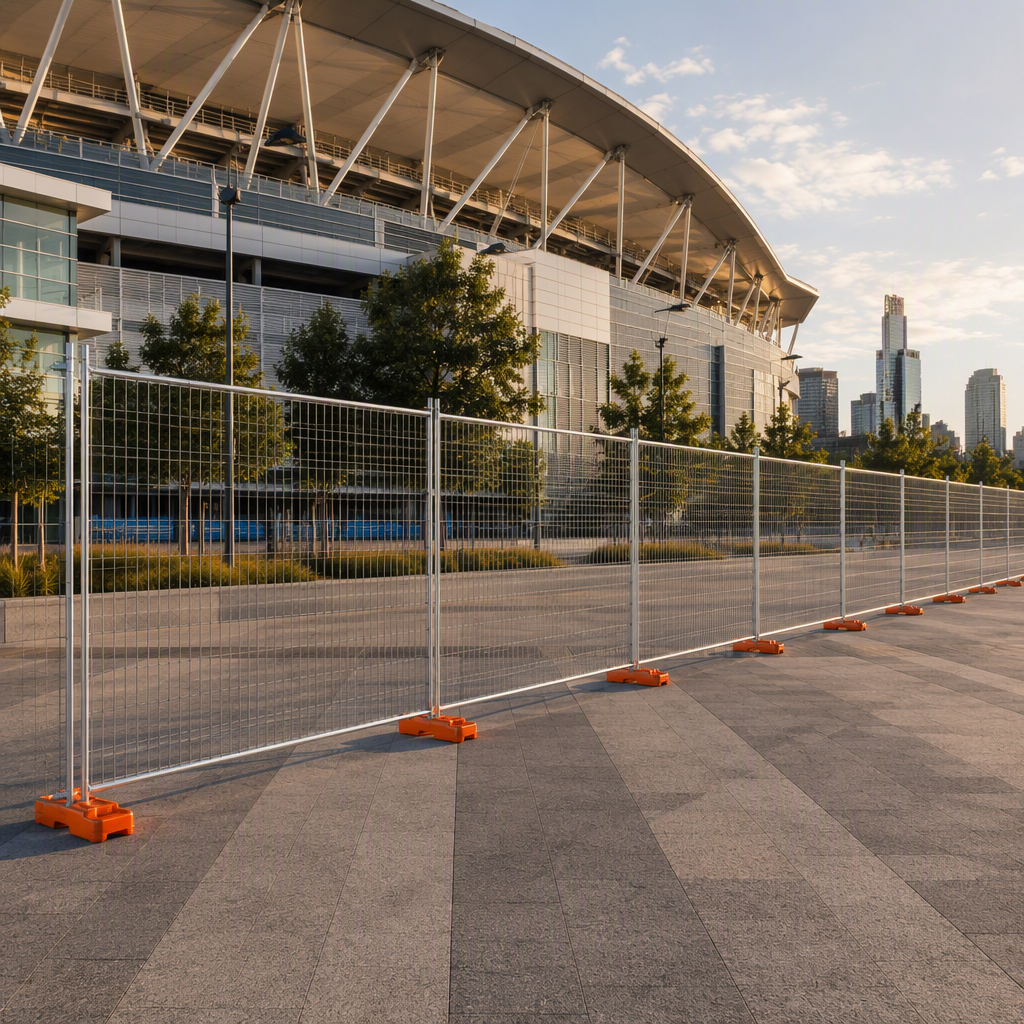
Events and crowd management put a different demand on the same product: it has to go up fast, follow an irregular footprint, and look deliberate. The clamps are what make this work. Set at 75 mm or 100 mm centres, they let a run turn a corner, follow a kerb or close a dogleg without cutting a single panel. Base feet are also where event organisers and hire businesses put their branding — a moulded logo or part number is one of the few genuinely useful anti-loss measures in a high-churn environment.
Questions We Hear Most Often
Q: How is Australian temporary fencing different from a Canadian or North American temporary fence?
Both formats enclose a site, but they are not interchangeable. Australian fencing uses a round-tube welded frame in a 2100 x 2400 mm panel, standing on 28 to 32 kg concrete-filled plastic feet in safety orange. The North American format typically uses a square-tube frame in an 1800 x 2900 mm or 2400 x 2900 mm panel, standing on welded steel bar feet, and is usually finished with galvanising plus powder coat. Different base systems mean different wind behaviour and different packing, so buy the format your market specifies.
Q: What specifications should I choose?
Three parameters matter most.
Tube wall thickness. This is the specification most often left off a quote, and the one that decides how many cycles a panel survives. Ask for it in writing, in millimetres.
Mesh opening. 60 x 150 mm is the Australian standard and the right answer for most sites. Go to 50 x 100 mm or 75 x 75 mm where you need a tighter barrier.
Base and bracing. Base mass holds the line in a gust; bracing stays decide whether the run survives the windy season. Specify bracing on the drawing rather than adding it after the first blow-over.
Q: How long will a panel last?
Corrosion protection decides it. Full hot-dip galvanising after fabrication is the base protection, and Guoxing panels carry a zinc coating of at least 42 µm, or approximately 300 g/m². In coastal or industrially polluted yards, that coating is doing more work than any other part of the specification. If you need documentation for a project file, ask your supplier for the coating records that apply to your order.
Q: How quickly does it install?
A panel drops into the twin sockets on its feet, and a hot-dip galvanised stamped clamp locks it to the next panel. No trenching, no concrete, no specialist tooling. Two people working from a ute can move and erect a substantial run in a day, which is the core reason temporary fencing replaced trench-set hoarding on most Australian sites.
Q: What drives the price?
Four factors: tube wall thickness, mesh opening, panel height and surface finish. Heavier tube, tighter mesh and additional coating all cost more. Base and post quality matter just as much — the fence is only as stable as what holds it up. When you compare quotes, compare like-for-like specification, because the cheapest quote is very often the one with thinner tube or lighter galvanising.
Q: Can the fence be customised?
Yes. Panel dimensions, tube OD and wall thickness, mesh opening, wire diameter and base branding can all be made to order, with a lead time that typically extends by two to four weeks. For large projects, request samples before committing to a full order — it is far cheaper than discovering a mismatch after the container lands.
Why Buyers Choose Guoxing Australian Temporary Fencing
Anping Guoxing Wire Mesh Products manufactures temporary fencing in the heart of the world's wire mesh industry — Anping, China. Every panel is produced under ISO 9001 quality control, with CE and SGS certification available on request. Factory-direct pricing means you pay for steel and labour, not for middlemen, and our export experience covers more than 30 countries across the Middle East, Europe, the Americas and Oceania.
Whether you are fencing a road rehabilitation, a residential development, an industrial yard or an event site, our engineers will help you specify the right tube wall, mesh opening, base configuration and finish — and supply the documentation your project file needs with every shipment.
Need a tailored quotation for your project? Contact the Guoxing team today — we respond to all inquiries within 24 hours.